A fast but fragile sprint
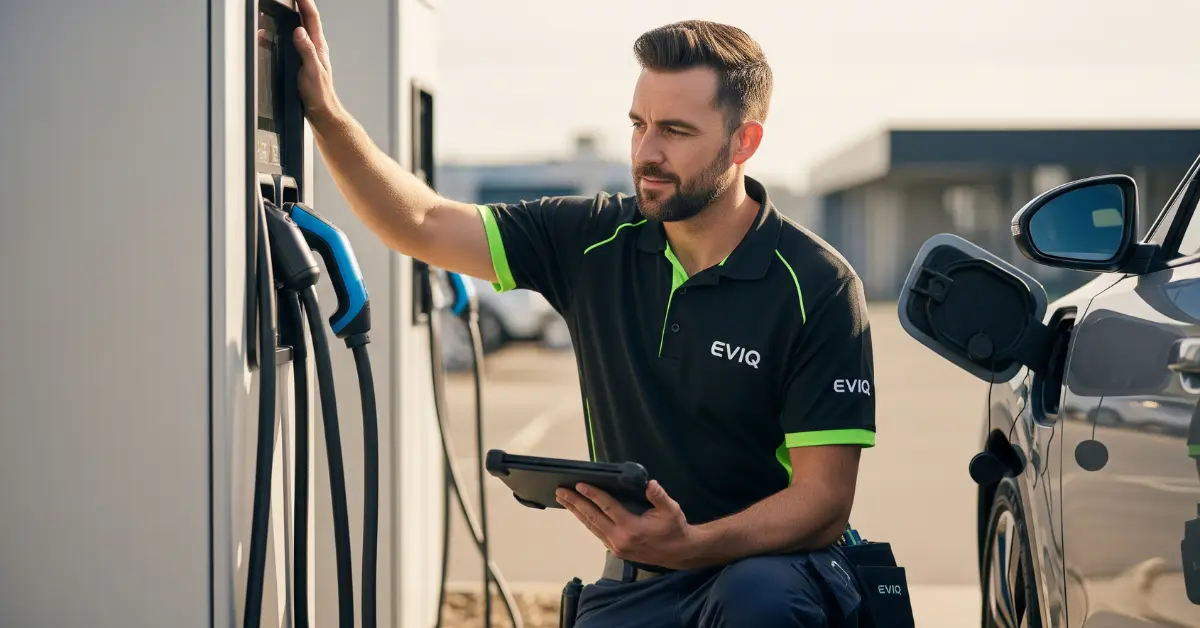
EVIQ fast chargers are now a public promise: the Electric Vehicle Infrastructure Company aims to deploy more than 5,000 fast chargers across Saudi Arabia by 2030. Yet by early 2025 the network shows just 88 chargers at 35 locations, a gap that forces a dramatic scaling plan if coast-to-coast EV travel is to become a reality.
Why this matters
If EVIQ succeeds, every day Saudis and the millions of pilgrims who travel between holy sites will find low-carbon travel far more practical. If it stalls, long-distance EV use — especially the 950–1,000 km Riyadh–Jeddah trip along Highway 40 — will remain difficult for the average EV owner.
Who’s behind the rollout
EVIQ is a state-backed joint venture between the Public Investment Fund (PIF) and the Saudi Electricity Company (SEC), pairing capital with grid know-how. The PIF lists EVIQ as a strategic vehicle to support Vision 2030’s sustainability and economic diversification targets.
Saudi auto market jumps 11.6% in H1 2025 — can the kingdom hit 1.04M cars this year?
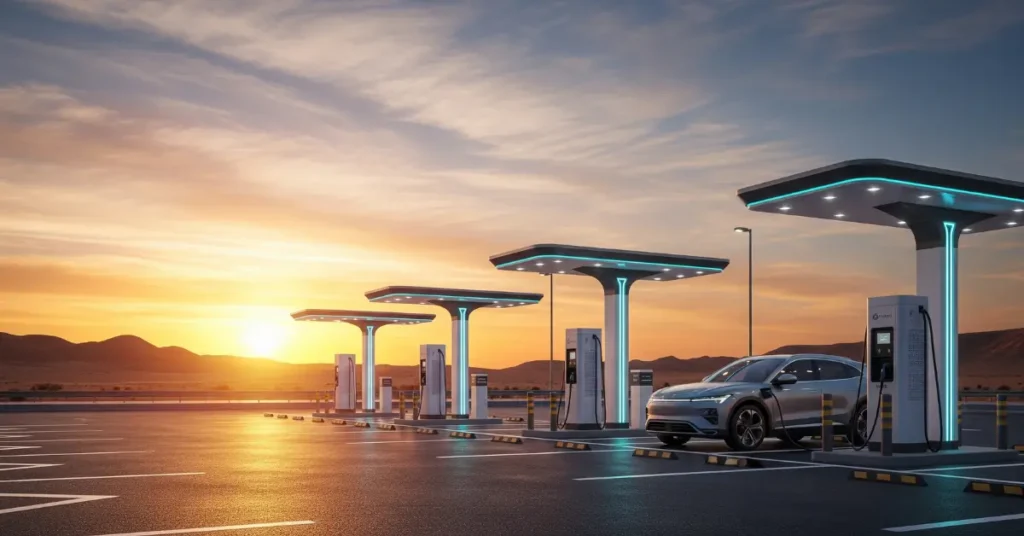
EVIQ has already placed proof-of-concept sites: its first public DC fast chargers opened at ROSHN Front (Riyadh) and the company launched its first highway station at SASCO Aljazeera on the Riyadh–Qassim route. These pilot sites use chargers rated at over 100 kW and signal a clear technical direction.
“This is a landmark moment for EVIQ… our plans to deploy 5,000 fast chargers across 1,000 strategic locations by 2030,” said Mohammad Bakr Gazzaz (CEO, EVIQ) when the ROSHN Front site opened.
The deployment math — steep and urgent
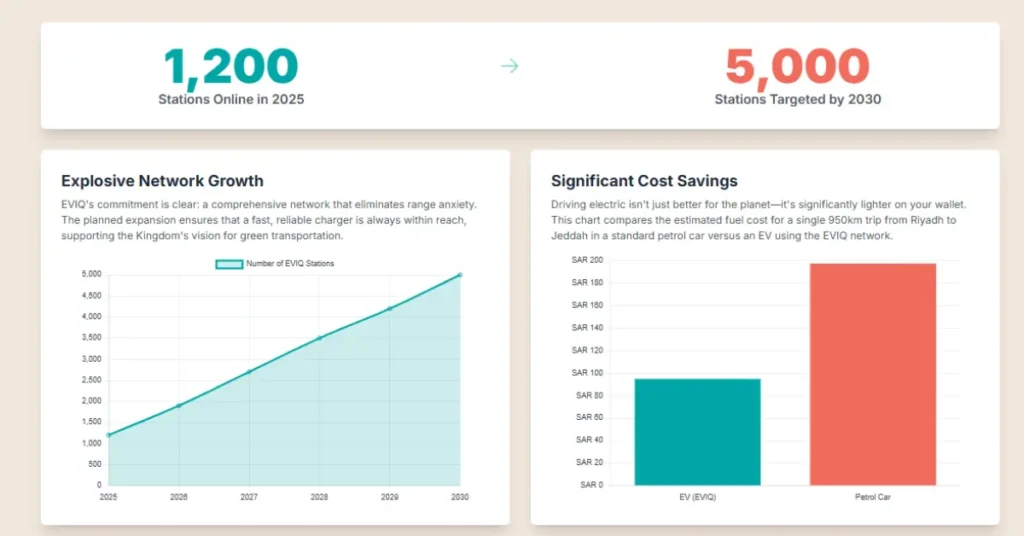
At the current pace (88 chargers in early 2025), EVIQ must install roughly 982 new chargers per year starting in 2026 to hit 5,000 by 2030 — roughly a fifty-fold jump from today’s run-rate. That scale-up requires supply contracts, land deals, grid upgrades, and a fast rollout of high-power hardware.
Table: Snapshot — Network now vs. 2030 goal
| Metric | Early 2025 (EVIQ) | 2030 Target | Note |
|---|---|---|---|
| Confirmed fast chargers | 88 | 5,000 | Aggressive scaling needed. |
| Confirmed locations | 35 | 1,000 | Aggressive scaling is needed. |
| Typical urban charger power | 100 kW+ | 150–350 kW | Highway travel needs higher power. |
| Priority highway routes | Riyadh–Qassim (live) | Nationwide, incl. Riyadh–Jeddah (H-40) | Mecca–Madinah is prioritized for pilgrims. |
The Riyadh–Jeddah challenge (Highway 40)
Highway 40 is about 950–1,000 km. For EVs with realistic highway range of 400–500 km, planners recommend at least two, ideally three fast-charging hubs spaced roughly every 250–350 km to maintain safe battery margins and allow preconditioning.
Projected optimal stops (2026/2027 estimate):
- Al Quwayiyah (~220 km from Riyadh) — initial buffer; 150 kW+ chargers.
- Afif (~480 km from Riyadh) — critical midpoint; multiple 200 kW+ chargers to reduce queues.
- Al Dawadmi (~740 km from Riyadh) — final range assurance before Jeddah.
Replicating the SASCO partnership model — integrating chargers into established highway service areas — is the fastest, lowest-risk path to coverage.
Price and economics: will EV trips cost more than petrol?
Public DC fast charging is costly to deliver at scale. While home/L2 charging remains cheap (residential tariffs around SAR 0.1744/kWh), commercial DC fast charging on highways is estimated in market analysis at roughly SAR 2–3/kWh. If highway charging were priced at SAR 2.50/kWh, a 100 km trip using DC fast charging could be more expensive than petrol on some calculations.
However, some market players now use a unified public tariff: E-FILL introduced a SAR 0.99/kWh flat tariff across its fast-charging network — a benchmark that, if widely adopted, would keep long-distance EV costs competitive with petrol.
Petrol reference: Saudi Aramco reports gasoline 95 at SAR 2.33/L (September 2025). This capped pricing must be considered when setting highway charging rates.
Environmental promise — but with caveats
EVIQ’s green case depends on the grid’s decarbonization. KAPSARC research shows EVs lower fleet emissions significantly, but the absolute CO₂ reductions hinge on the power mix and renewable rollout. In short: EV uptake plus cleaner electricity equals meaningful emissions cuts; chargers simply shift where the energy demand sits.
App, safety, and customer experience
EVIQ’s mobile app attempts to reduce range-and-queue anxiety by showing real-time availability, connector types, and amenities — a vital element for trust on long corridors. Hardware must also meet international safety standards for high ambient temperatures and dust, a specific Saudi operating constraint that EVIQ’s R&D centre is testing for.
Bottom line — what should happen next?
EVIQ has solid institutional backing and clear early wins. The next 18 months are decisive: EVIQ should prioritize the three Riyadh–Jeddah hubs (Afif must be high capacity), announce a standardized highway tariff to build consumer confidence, and publish clear renewable-energy sourcing via PPAs to validate environmental claims. These moves will determine whether Highway 40 becomes EV-ready by late 2026–2027, or remains a gap in Saudi electrified mobility.
Expert outlook
Analysts say the technical pieces exist, but execution speed, tariff transparency, and grid reinforcement will decide success. KAPSARC modelling suggests the emissions upside is real — provided renewables expand in parallel.
Shareable close
EVIQ fast chargers are a national experiment in speed: will policy, money, and engineering converge before 2030? The next two years will tell. If you care about cleaner roads, share this story — the Riyadh–Jeddah corridor is the battleground for Saudi EV confidence.

Hey, I’m Arafat Hossain! With 7 years of experience, I’m all about reviewing the coolest gadgets, from cutting-edge AI tech to the latest mobiles and laptops. My passion for new technology shines through in my detailed, honest reviews on opaui.com, helping you choose the best gear out there!







 English
  Arabic