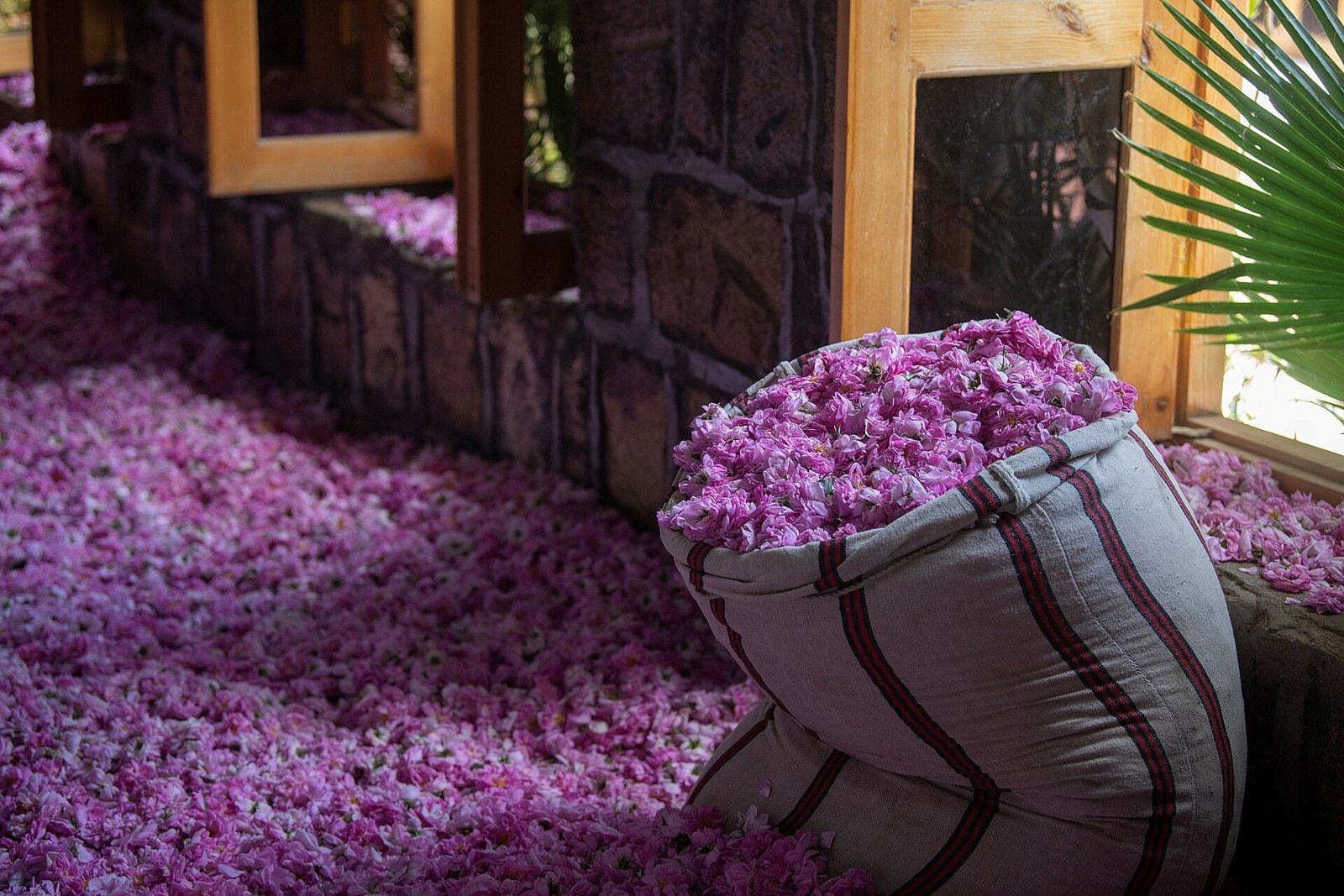
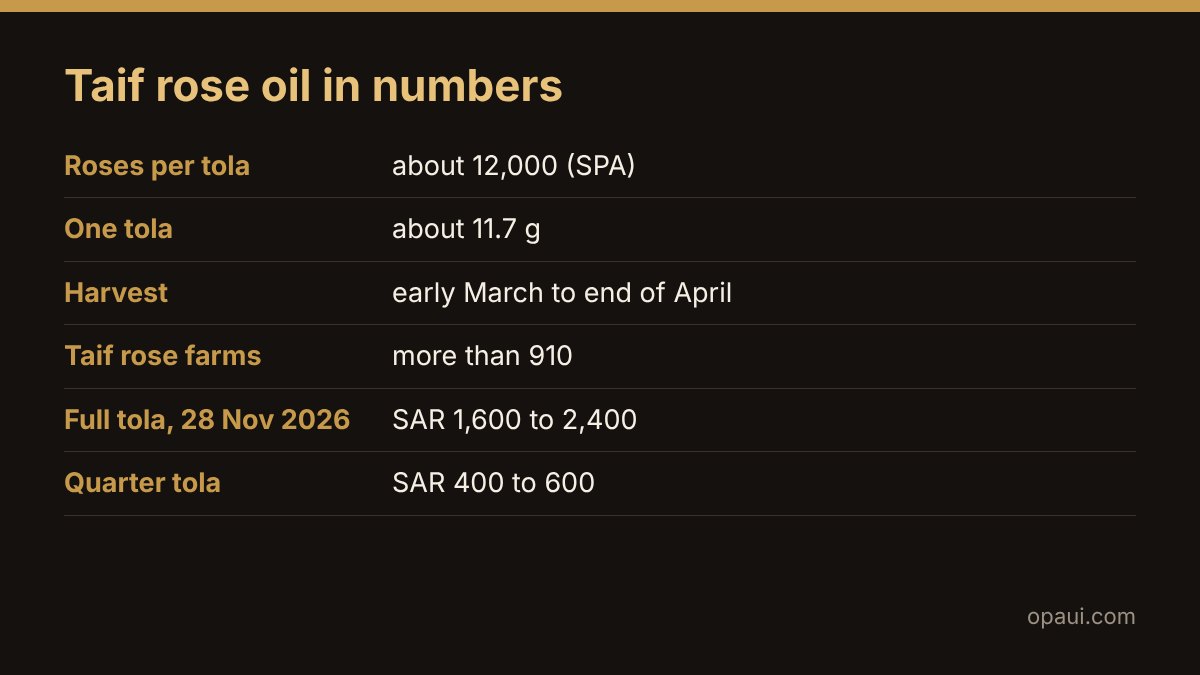
A full tola of Taif rose oil from sellers in Taif cost between SAR 1,600 and SAR 2,400 when we checked their websites on 28 November 2026, and a quarter tola cost SAR 400 to 600. The reason is simple arithmetic: the Saudi Press Agency puts the yield at about 12,000 hand-picked roses for one tola of oil.
So if someone offers you “pure Taif rose” for the price of a dinner, you already have your answer. This guide explains what a tola actually is, how to read the labels sellers use, and how to avoid paying Taif prices for a blend.
The Opaui take
For a first bottle or a gift, buy a quarter tola from a Taif distiller that prints the harvest year, and expect to pay around SAR 400 to 500. A quarter is enough to learn whether you love the smell on your own skin before you spend four times as much. Ask for the weight in grams, and pay extra for labels such as “petal oil” only after the seller explains in plain words what you get for it.
How much is a tola of Taif rose oil, in grams and ml?
The tola is an old weight unit, still used across the Gulf for gold. The Saudi Press Agency gives it as 11.7 grams when it describes Taif rose oil, which matches the standard value of about 11.66 grams.
Here is the catch. Most oil shops sell the tola as a bottle size, not as a weight they print on the label. Very few listings state millilitres. Because rose oil is lighter than water, 11.7 grams of oil takes up a little more than 11.7 ml, so do not compare a “tola” with a 12 ml roll-on and assume they are equal. Ask the seller one question: how many grams are in this bottle? A clear answer is a good sign in itself.
Once you have the grams, compare prices per gram. That turns three confusing listings into numbers you can line up.
Prices from three Taif sellers (checked 28 November 2026)
| Seller and grade | Quarter tola | Full tola | Per gram (full tola) |
|---|---|---|---|
| Ward Al-Shafa, 1447 AH (2026) harvest | SAR 400 | SAR 1,600 | about SAR 137 |
| Bin Moshiheb | SAR 460 | SAR 1,725 | about SAR 147 |
| Ward Al-Shafa, wood-fired distillation | SAR 450 | SAR 1,800 | about SAR 154 |
| Diwan Al Ward | SAR 500 | SAR 2,000 | about SAR 171 |
| Ward Al-Shafa, petal oil, 2026 harvest | SAR 600 | SAR 2,400 | about SAR 205 |
Prices were read on each shop’s own website, last checked 28 November 2026, and may change. The per-gram column assumes 11.7 grams in a full tola. Stock was not always shown, so confirm before you order.
Why does a few grams of rose oil cost so much?
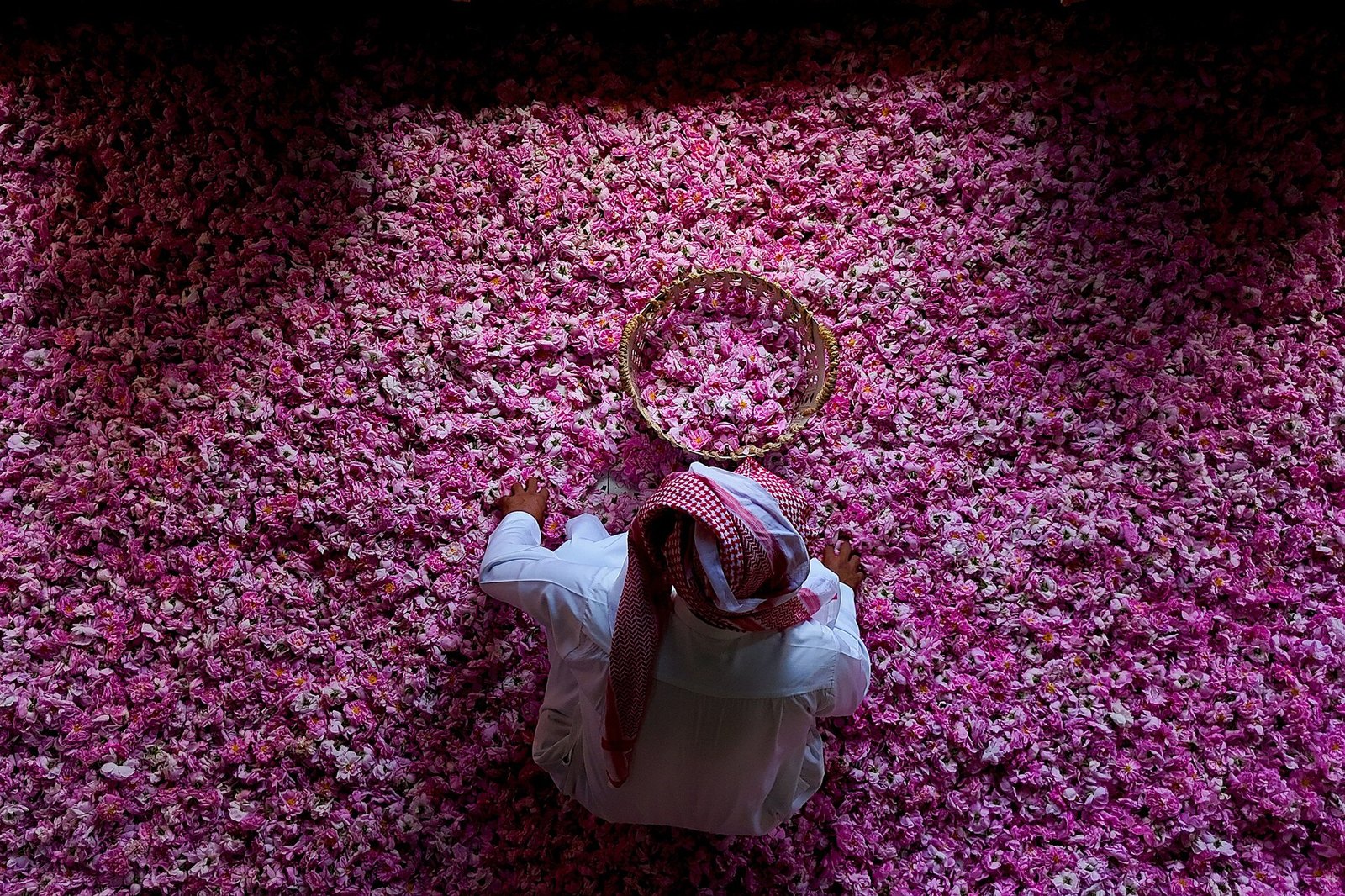
Start with the flowers. In January 2026 the Saudi Press Agency counted more than 910 rose farms around Taif, in Al-Hada, Al-Shafa, Wadi Muharram and nearby valleys. The roses are picked by hand before dawn and distilled within 24 hours, and picking is squeezed into a window of roughly six weeks across March and April. The agency puts one season’s output at about 20,000 tolas of oil for the entire region.
The Ministry of Environment, Water and Agriculture gives a higher count of more than 960 million roses a year. Official estimates differ, but every one of them points to the same thing: a tiny amount of oil from a mountain of petals.
Weather moves the price too. Arab News reported in May 2025 that rain during the plants’ dry resting period weakened the buds, cut the yield and pushed a bottle to SR1,800, up SR600 on the year before. That bottle needed about 12,000 roses, the same count the press agency gives for a tola.
There is also heritage value. In December 2024, UNESCO added the cultural practices related to Taif roses to its list of the intangible cultural heritage of humanity, after a nomination from Saudi Arabia.
Harvest year, wood fire, petal oil: what the labels tell you
Taif sellers use a handful of words that shift the price, and none of them has an official definition you can check.
Harvest year. Listings such as “1447 harvest” tell you the season the roses were picked. The 1447 season was spring 2026. This is the most useful label of all, because it lets you compare like with like.
Wood-fired. Some distillers advertise oil distilled over a wood fire. Ward Al-Shafa charged SAR 200 more per tola for it.
Petal oil. This was the most expensive grade we found, SAR 800 a tola above the standard oil from the same seller. The seller’s page does not explain the difference in detail, so ask before you pay the premium.
Two more words matter. “Dehn ward” on its own simply means rose oil, from anywhere. And a “Taif rose perfume” is usually a spray made with alcohol and other materials, a different product from the pure oil, priced on different terms.
How do you know Taif rose oil is real?
Honestly, you cannot prove it with your nose. The American Botanical Council’s adulterants programme published a bulletin on damask rose oil in June 2024, and it lists the usual tricks: adding rose-smelling compounds such as geraniol and citronellol, cutting the oil with cheaper geranium or palmarosa oil, or blending in oil from other roses. Laboratories confirm purity with gas chromatography (GC-MS), not with a sniff.
What a buyer in the Kingdom can do:
- Use the price floor. With about 12,000 roses behind one tola, a “pure Taif” quarter tola sold for SAR 15 or 50 is a blend or a different oil, whatever the label says.
- Buy from the distiller or a named Taif shop that states the harvest year and the weight. Anonymous listings with no harvest year are the riskiest.
- Ask whether a lab analysis exists for the batch. A missing report is not proof of fraud, but a seller who can show one is asking for less blind trust.
- Do not judge by colour or crystals. The same bulletin gives a freezing point of roughly 16 to 23.5°C for damask rose oil and describes it as liquid or partly crystallised at 25°C. A cool Riyadh evening or a strongly air-conditioned room can turn real oil cloudy or slightly solid; warm the bottle in your hand and it clears. But fakers add waxes to copy this, so cloudiness alone proves nothing.
If you are weighing the old oud and rose houses against newer Saudi names, our guide to Saudi perfume brands sets them side by side.
Buying in winter: what is on the shelf now
From December to February the farms are quiet. UNESCO’s description of the practice says this is when farmers fertilise, water, prune and plant cuttings, and the new flowers only come in March. So any oil you buy this winter comes from the spring 2026 harvest, or an older one. That is fine, as long as the label says which.
Winter is also when demand for gifts peaks, with weddings, family visits and travel. UNESCO notes that Taif families have long given rose products to relatives and friends, including people outside Taif, and a small bottle still makes a thoughtful present for a mother or grandmother. If you are flying with it, our guide to travelling with perfume in Saudi Arabia explains the carry-on limits.
How to wear it without wasting it
Rose oil is concentrated and has no alcohol, so it is applied with the glass stick or a fingertip, not sprayed. A touch on the wrists and behind the ears is the usual way. A common habit in the Kingdom is to wear it on skin and let oud or bukhoor scent the thobe or abaya, so the rose stays close while the smoke carries further. If you already own a dehn al oud, our Ajmal Dahn Al Oudh review shows the kind of oud oil people pair it with.
Keep the bottle closed, upright and out of the car. Saudi summer heat inside a parked car is no place for an oil that costs more than SAR 100 a gram.
Who should skip it
Skip it if you want a scent people notice from across the majlis. Pure rose oil stays close to the skin, and a strong spray will serve you better. Skip it too if real roses are not your smell; a perfume that uses rose as one note costs far less and may please you more.
Budget matters here. Under about SAR 300, a quarter tola from a named Taif shop is out of reach, and the cheap “pure” bottles are not a true substitute. An honestly labelled blend, or a few months of saving, is the better route. And if essential oils tend to irritate your skin, try a tiny amount on the inner arm first, or leave it.
Frequently asked questions
How many ml are in a tola of Taif rose oil?
A tola is a weight of about 11.7 grams. Because the oil is lighter than water, that is slightly more than 11.7 ml. Ask the seller for the weight, since most bottles do not show it.
Is Taif rose the same as Bulgarian rose?
Both are forms of the damask rose (Rosa × damascena), and the American Botanical Council bulletin lists “Taif rose” among its common names. The difference is where and how it is grown and distilled, which shapes the smell and the price.
Why does my rose oil look cloudy in winter?
Damask rose oil starts to solidify at around 16 to 23.5°C, so a cold room can make it cloudy. Warm it gently in your hand. This is normal, but it is not a test of purity.
When is the best time to buy Taif rose oil?
Fresh oil comes from the March to April harvest. In winter you are buying the previous harvest, so check the year on the label.
Is a SAR 15 rose oil real Taif rose?
No. At about 12,000 roses per tola, pure Taif oil cannot be sold at that price. It may still smell pleasant, but it is a different product.
How we put this together
We checked figures from the Saudi Press Agency (January 2026), the Ministry of Environment, Water and Agriculture, UNESCO’s 2024 listing, Arab News reporting from Taif (May 2025 and August 2026) and the American Botanical Council’s June 2024 bulletin on rose oil. Prices come from the websites of Ward Al-Shafa, Bin Moshiheb and Diwan Al Ward, last checked 28 November 2026. Opaui has not smelled, tested or lab-checked any of these oils, and no seller paid to be included.

Tanvir Hosen
Tanvir Hosen is a fragrance reviewer based in Saudi Arabia, originally from Bangladesh, specializing in perfume performance testing under Middle Eastern climate conditions. With over three years of experience reviewing designer and accessible luxury fragrances, he evaluates scent structure, projection strength, heat resistance, and long-term wearability.
His reviews are focused on helping Saudi and GCC consumers select fragrances that perform reliably in high temperatures while remaining office-appropriate and socially versatile.